Teaching Graphic Novels with Rigor: How to Assess Students Without Lowering the Bar
One of the biggest concerns teachers have when teaching graphic novels is assessment.
It’s easy to use graphic novels for engagement.
It’s harder to assess them in ways that feel academically rigorous.
Many educators worry that if students read a graphic novel instead of a traditional novel, the assessment might be easier or less credible.
But that assumption overlooks something important.
Graphic novels require students to read two layers of text simultaneously:
- Written dialogue and narration
- Visual storytelling and symbolism
When we assess both layers intentionally, graphic novels become powerful tools for evaluating deep literacy skills.
In fact, they allow students to demonstrate analysis that traditional novels often cannot.
In the previous posts in this series, we explored:
- Why graphic novels build rigorous literacy skills
- How to select strong titles for the classroom
- Strategies for teaching visual literacy and analysis
- How to structure a full graphic novel unit
Now we focus on the final piece:
How to assess student learning while teaching graphic novels with rigor.
Why Assessment Matters when teaching Graphic Novels
If assessment only checks basic comprehension, students will treat graphic novels like simple stories.
But when assessments require analysis of visual structure, symbolism, and author craft, students begin reading graphic novels much more carefully.
Strong assessments should require students to:
- Interpret visual evidence
- Analyze author choices
- Support claims with textual and visual proof
- Connect themes across the narrative
When teaching graphic novels, the goal is the same as any literature unit:
critical thinking, interpretation, and evidence-based writing.
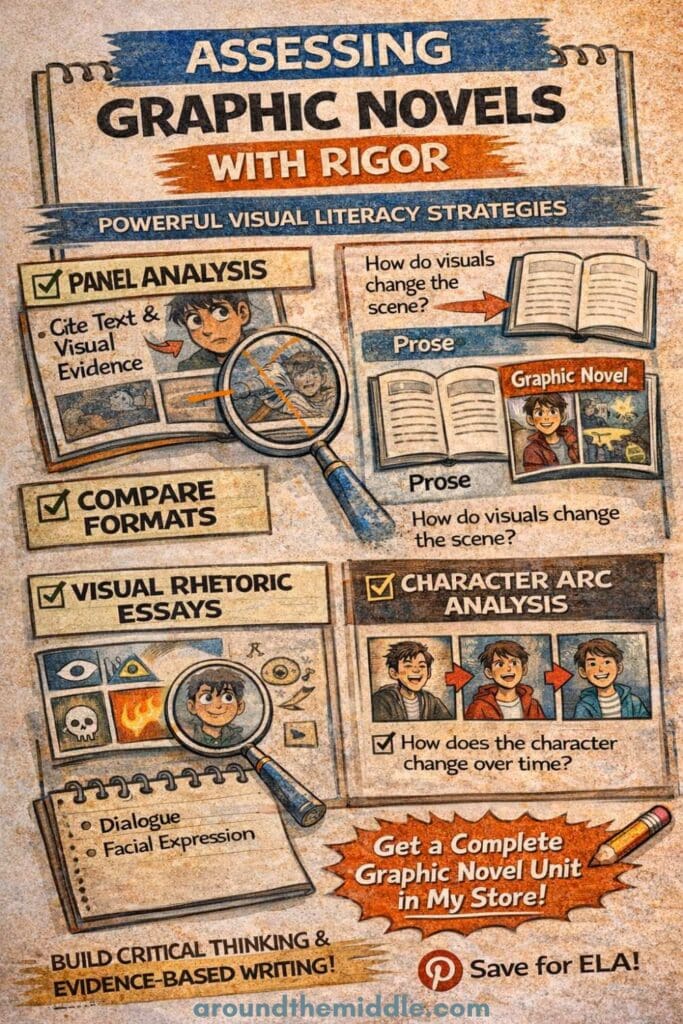
Strategy 1: Analytical Paragraphs Using Panel Evidence
One of the simplest ways to assess graphic novel understanding is through short analytical writing.
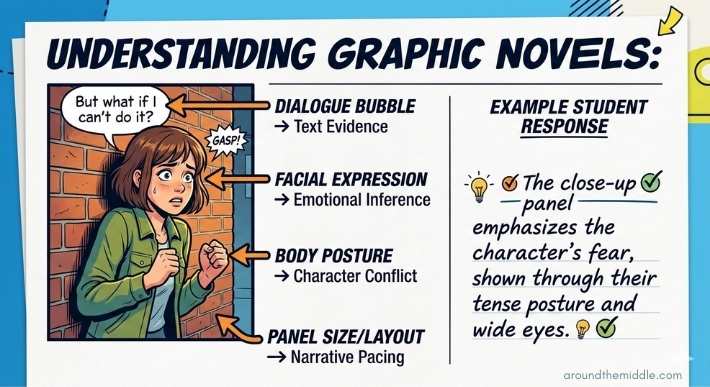
Students examine a specific panel or page and respond to a prompt such as:
- How does the panel layout reinforce the theme of the scene?
- What does the character’s body language reveal about their internal conflict?
- How does color or framing influence the reader’s interpretation?
Students must cite both:
- Dialogue or narration
- Visual details within the panel
This pushes students to treat graphic novels as complex texts rather than illustrated stories.
Sentence frames can help scaffold this type of writing while still maintaining rigor.
Strategy 2: Compare Graphic and Prose Adaptations when teaching graphic novels
Another powerful assessment is a comparison between formats.
Students analyze how a scene changes when presented as:
- prose text
- graphic novel panels
Possible prompts include:
- Which format conveys emotion more effectively?
- How do visuals change the pacing of the scene?
- What details are lost or gained in the graphic format?
This type of assignment strengthens critical media literacy and encourages students to evaluate storytelling techniques.
Strategy 3: Visual Rhetoric Essays
Graphic novels rely heavily on visual rhetoric—the use of images to influence meaning.
Students can write short essays analyzing elements such as:
- panel pacing
- perspective and framing
- symbolism in background imagery
- facial expressions and body language
For example, students might analyze how panel size and spacing slow down or accelerate narrative tension.
Assignments like this push students to examine author craft at a sophisticated level.
Strategy 4: Character Arc Analysis for teaching graphic novels
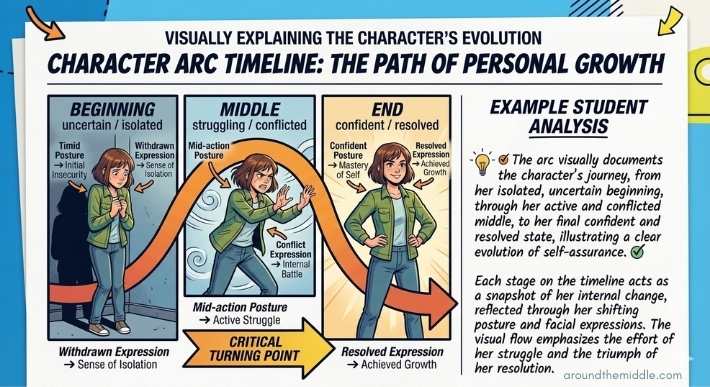
Character development in graphic novels often appears through both dialogue and visuals.
Students can write essays analyzing how a character evolves throughout the story.
Key questions might include:
- What visual cues reveal the character’s emotional changes?
- How do relationships shift across the narrative?
- Which scenes represent turning points?
Students should reference specific panels as evidence, just as they would cite passages in a traditional novel.
This reinforces the expectation that graphic novels deserve the same analytical treatment as other literature.
Strategy 5: Thematic Hexagonal Thinking Maps
Hexagonal thinking is an excellent way to assess theme development and connections.
Students receive hexagons labeled with elements such as:
- characters
- conflicts
- symbols
- key events
- themes
They must arrange the hexagons and explain how ideas connect.
This activity reveals whether students truly understand the relationships between story elements.
It also encourages discussion and collaborative reasoning before formal writing assignments.
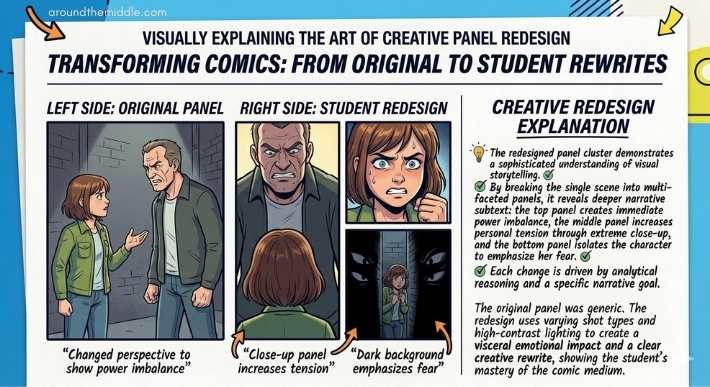
Strategy 6: Creative Panel Rewrites with Written Justification
Creative work can still be rigorous when paired with analysis.
Students rewrite or redesign a panel from the graphic novel.
Possible tasks include:
- Changing the perspective of the scene
- Reframing the panel layout
- Altering the emotional tone
But the key requirement is written justification.
Students must explain:
- why they made their design choices
- how those choices affect the story’s meaning
- what the new panel communicates to the reader
This combines creativity with metacognitive reflection and textual analysis.
Designing Assessments that Reflect Real Literacy Skills when teaching graphic novels
When teaching graphic novels, the best assessments mirror the same thinking skills used in traditional literature studies.
Students should demonstrate the ability to:
- interpret symbolism
- analyze structure
- evaluate character development
- support arguments with evidence
- connect ideas across the text
Graphic novels simply provide more ways for students to show these skills.
They invite students to read closely, think critically, and communicate their ideas clearly.
Bringing the Series Together
Over the past several weeks, this series has explored how teaching graphic novels can transform reading instruction.
We’ve looked at:
- Why graphic novels build rigorous literacy skills
- How to choose strong titles for the classroom
- Strategies for teaching visual literacy and analysis
- Ways to structure engaging graphic novel units
- Methods for assessing student understanding
Graphic novels are not a shortcut.
They are a different kind of text that demands sophisticated reading skills. When we teach them intentionally, students develop deeper analytical thinking, stronger discussion skills, and greater engagement with literature.
And that leads to the most important takeaway of this series:
If we assess them with rigor, we teach them with rigor.
Ready to Teach and Assess Graphic Novels with Confidence?
If you want to implement these strategies without spending hours planning, you can use the complete graphic novel unit available in my store. You can even grab lesson one for free here!
This unit is designed to help teachers teach and assess graphic novels with real academic rigor while keeping students engaged.
It works with any graphic novel, so you can use it with the titles you already teach or adapt it to new books each year.
Inside the unit, you’ll find everything you need to run a structured and academically strong graphic novel study, including:
- Pre-reading activities that build background knowledge
- Visual literacy lessons that teach students how to analyze panels and symbolism
- Structured discussion prompts and debate activities
- Graphic novel analysis tasks and writing assignments
- Rigorous assessment tools aligned with higher-level thinking skills
Instead of piecing together activities from multiple sources, you’ll have one complete system for teaching graphic novels from beginning to end.
If you’re ready to run a successful, engaging, and academically robust graphic novel unit, you can explore the full resource in my store and start implementing it right away.
Happy teaching!