




Latest News
-

The Active Novel Study ideas Framework: An Ultimate Guide for ELA
The Ultimate Active Framework for Novel Study Ideas in Middle School ELA We’ve all been there: the collective groan that ripples through the classroom when a thick book is placed on a student’s desk, followed by the inevitable question, “Are we just doing a worksheet packet for this?” At In Around the Middle, I believe…
-
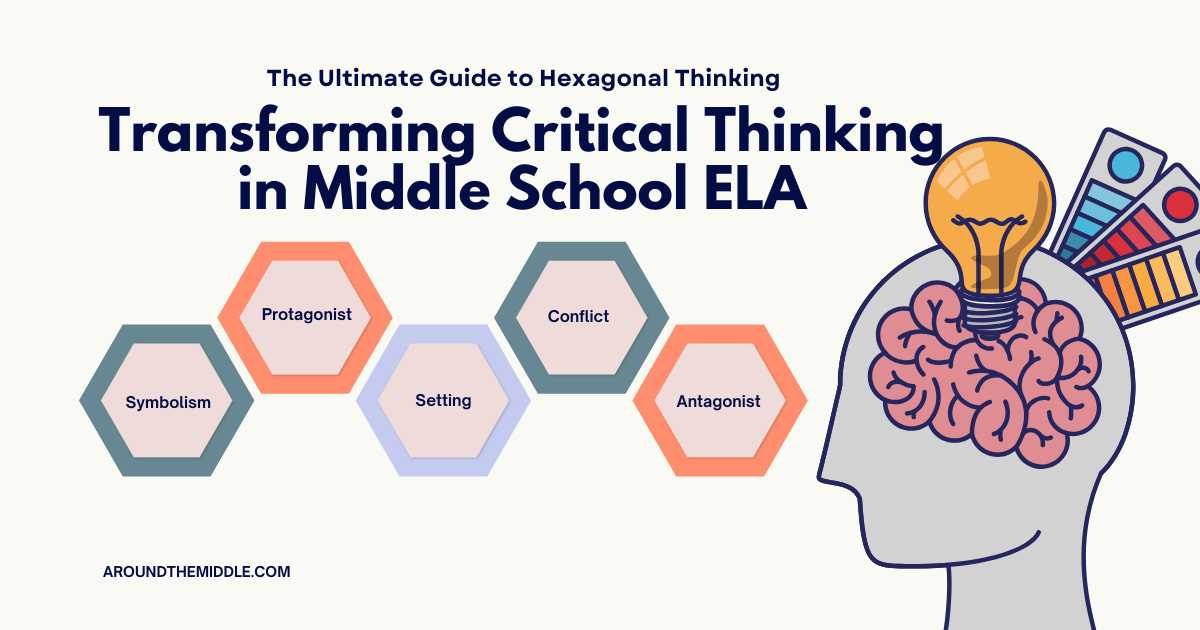
The Ultimate Guide to Hexagonal Thinking: Transforming Critical Thinking in Middle School ELA
Middle school ELA classrooms often face a common hurdle: students who are reluctant to engage with complex literary analysis because it feels too abstract or overwhelming. Hexagonal Thinking is the pedagogical bridge that turns “scary” critical thinking into a tactile, movement-based puzzle. By shifting the focus from a blank page to a hands-on connection map,…
-
Ditch the Essay: 3 Amazing Novel Study Final Project Ideas to Unleash Success
It’s Sunday night. You’re staring at a stack of 60 identical essays, a lukewarm coffee in hand, and that familiar sense of grading dread. We’ve all been there. We want rigor, we want proof of comprehension, but the “standard” essay often results in “standard” (read: uninspired) student work and an even more uninspired teacher. It’s…
-
Forget the Essay: 3 Surprising Novel Study Final Project Ideas Your Students Will Love
We’ve all been there: the book is finished, the big class discussions are over, and then… the energy in the room disappears. Usually, this happens the moment we assign the traditional five-paragraph essay. While writing is important, an essay isn’t the only way for students to show they truly “get” the book. But coming up…
-
Reclaim Your Sunday! Grading Novel Study Activities Without The Burnout
We’ve all been there. It’s Sunday afternoon, and while the rest of the world is relaxing, you’re buried under a mountain of 120 chapter-question packets. Your red pen is running dry, and—let’s be honest—you know half of those answers were copied from a summary site anyway. The joys of grading novel study activities! If we…
-
Tired of the “Theme” Struggle? 5 Powerful Novel Study Activities for Deep Discussion
If you ask a middle schooler, “What is the theme of this book?” you’ll likely get one of two things: a blank stare or a one-word answer like “friendship” or “war.” Not exactly what you want from your novel study activities. In my experience, students often treat theme like a “hidden treasure”—a secret code they…
-
Beyond the Packet: 5 Engaging Novel Study Activities for Powerful Thinking
We’ve all been there with our novel study activities. You finish a powerful chapter of a novel, the room is quiet, and then comes the sound that kills the momentum: the rustling of 30 packets being pulled out of desks. Traditional novel study activities have relied on the “chapter question” model for decades. It’s the…
-
Why Most Novel Study ideas Fall Flat (And How to Fix It)
If you’ve been searching for better novel study ideas, you’ve likely run into the same frustration: most approaches look good on paper but fall flat in the middle school classroom. Students complete the work. They answer the questions. They stay busy. But they aren’t thinking deeply. This is the gap most novel study ideas fail…
-
Teaching Graphic Novels in the Classroom: The Complete Guide for Upper Elementary and Middle School
Graphic novels are no longer just “reluctant reader books.” When taught well, they develop visual literacy, inferential thinking, and deep literary analysis. In fact, many graphic novels require students to interpret symbolism, panel structure, perspective, and visual storytelling in ways traditional novels do not. Yet many teachers still wonder how to teach them with real…
-
Teaching Graphic Novels with Rigor: How to Assess Students Without Lowering the Bar
One of the biggest concerns teachers have when teaching graphic novels is assessment. It’s easy to use graphic novels for engagement.It’s harder to assess them in ways that feel academically rigorous. Many educators worry that if students read a graphic novel instead of a traditional novel, the assessment might be easier or less credible. But…