Ditch the Essay: 3 Amazing Novel Study Final Project Ideas to Unleash Success
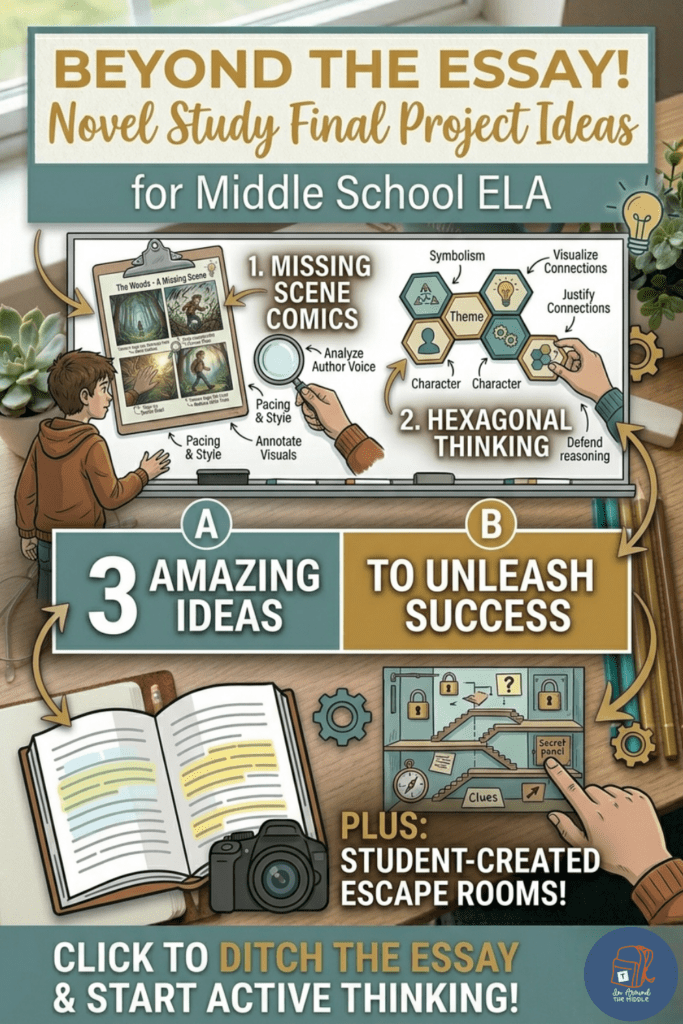
It’s Sunday night. You’re staring at a stack of 60 identical essays, a lukewarm coffee in hand, and that familiar sense of grading dread. We’ve all been there. We want rigor, we want proof of comprehension, but the “standard” essay often results in “standard” (read: uninspired) student work and an even more uninspired teacher. It’s time for some new novel study final project ideas.
I’m a big believer that we need to move away from the “Sit and Get” model. My goal is Active Thinking. We want students to create, defend, and analyze in ways that actually stick.
This post is the final piece of our series on transforming ELA assessments. If you missed the deep dives into these specific strategies, catch up here:
Part 1: Why Most Novel Studies Fall Flat – And How to Fix Them
Part 2: Beyond the Packet: 5 Engaging Novel Study Activities for Powerful Thinking
Part 3: Tired of the “Theme” Struggle? 5 Powerful Novel Study Activities for Deep Discussion
Part 4: Reclaim Your Sunday! Grading Novel Study Activities Without The Burnout
Part 5: Forget the Essay: 3 Surprising Novel Study Final Project Ideas Your Students Will Love
1. Novel Study Final Project ideas – The Missing Scene Comic Strip (Visual Literacy)
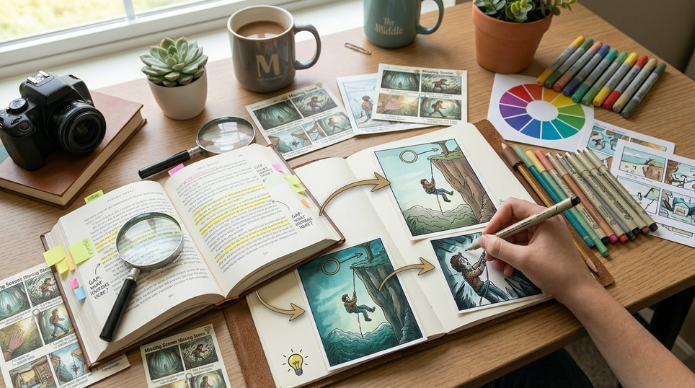
Instead of asking students to describe a character’s internal conflict, why not have them draw the moment it happens? The Missing Scene Comic Strip is a powerhouse assessment that forces students to find “gaps” in the text—moments the author chose to leave off-page.
- Find the Gaps: Students pinpoint crucial moments the author left un-shown.
- Select Visual Techniques: They must choose camera angles (like low-angle for isolation), style (like expressionism to convey panic), and color to match the author’s established voice.
- Draw & Annotate: Students illustrate the scene and explain how their visual choices prove their literary analysis.
This isn’t just “drawing”; it’s a high-level analysis of pacing, style, and mood. It’s also a great way to incorporate visual literacy into your novel study final project ideas.
2. Student-Created Escape Rooms (Synthesis & Logic)
Why should you have all the fun (and work) of designing an escape room? Turn the tables! This project moves students from basic recall to deep chapter synthesis.
- Rigor: Requires deep chapter recall and synthesis of minor details to create functional codes.
- Logic Puzzles: Students design evidence-based challenges for their peers, ensuring every “clue” is rooted in the text.
- Active Engagement: This is a collaborative, problem-solving design project that turns students into the experts of their novel.
3. Hexagonal Thinking Maps (Visualizing Connections) – novel study final project ideas
If you want to see your students’ brains actually working, give them hexagons. Hexagonal Thinking is a spatial discussion tool where students move tiles to show how themes, characters, and symbols connect.
- Synthesize Themes: Students must justify the connections between complex themes and character relationships.
- Critical Discussion: The magic happens in the “why”—why does this “Symbol” tile touch the “Theme” tile? Students must defend the placement of every hexagon.
- Versatility: This can be done as a large-scale physical map on the classroom floor or a digital collaboration.
Stop the Grading Madness
The best part? These aren’t just “fun” activities; they are rigorous assessments designed to show you exactly what a student understands. When paired with Single-Point Rubrics, grading becomes faster and more meaningful for everyone involved. No more hunting for a thesis statement—the evidence is right there in the panels, puzzles, and maps.
Ready to transform your classroom? Download my FREE Graphic Novel Lesson One and 8-Week Scope and Sequence It includes my 8-week scope and sequence, lesson one of the graphic novel unit, and everything you need to start teaching visual literacy today.
Happy Teaching!