Beyond the Packet: 5 Engaging Novel Study Activities for Powerful Thinking
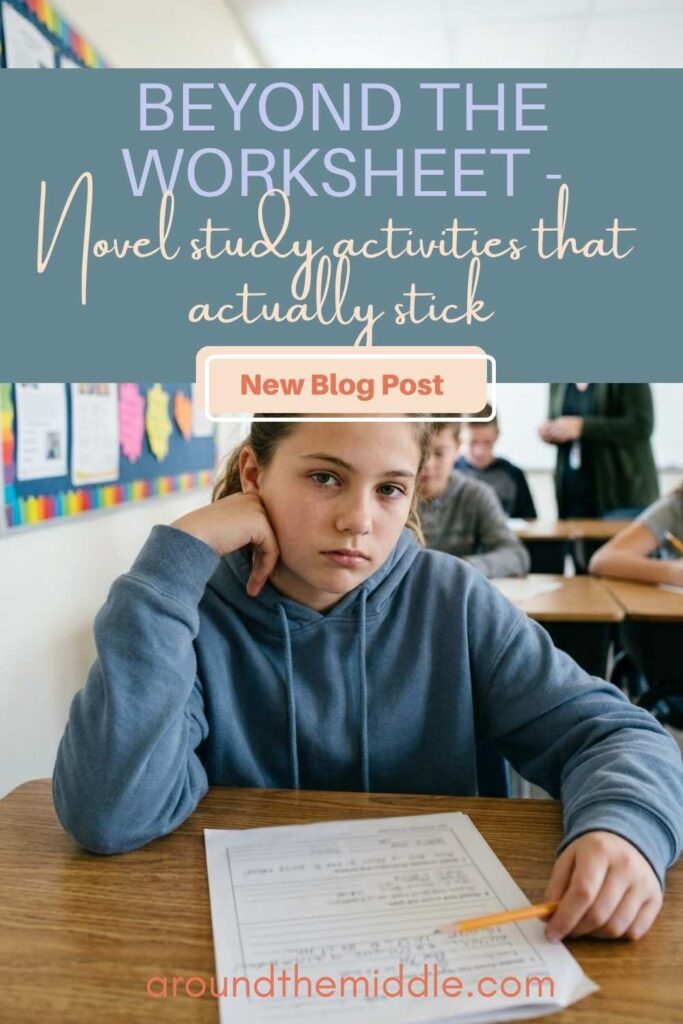
We’ve all been there with our novel study activities. You finish a powerful chapter of a novel, the room is quiet, and then comes the sound that kills the momentum: the rustling of 30 packets being pulled out of desks.
Traditional novel study activities have relied on the “chapter question” model for decades. It’s the ultimate safety net. It proves they read. It keeps them quiet. It’s easy to grade.
But it’s also where deep thinking goes to die.
If we want our students to move beyond passive compliance (or the growing threat of anarchy), we have to swap “Question & Answer” for “Evidence & Action.” Here is how to move beyond the worksheet and implement novel study activities that actually stick.
Why Chapter Questions are a “Safety Net” (And Why to Let Go)
Most comprehension questions are designed for accountability (did they read?) rather than instruction (did they learn?). When every chapter is followed by a list of literal recall questions, students learn to “hunt and peck” for keywords rather than immersing themselves in the story.
To build active thinking, we need High-Floor, High-Ceiling tasks: novel study activities that every student can enter, but that have no limit on how deep the analysis can go.
1. The “Value Line” Debate (Movement-Based Learning)
The Shift: Instead of answering a character motivation question on paper, students physically take a stand.
How to do it: Present a polarizing statement about a character’s choice. For example: “In Chapter 4, the protagonist’s lie was a necessary act of protection.” Students stand on a literal line across the classroom—one end is “Totally Justified,” the other is “Unforgivable.”

Why it builds rigor: Students can’t just “hide” in their notebooks. They have to physically commit to a claim and then—crucially—justify their spot on the line using specific text evidence. It turns a dry novel study into a high-stakes discussion. This is such a great activity and really gets students discussing and debating without you!
2. Hexagonal Thinking: Interconnected Novel Study Activities
The Shift: Replacing the “Theme Worksheet” with non-linear synthesis.
How to do it: Give small groups a set of hexagons containing character names, motifs, plot points, and abstract concepts (like betrayal or resilience). Students must arrange the hexagons so that every touching side represents a logical connection they can explain.
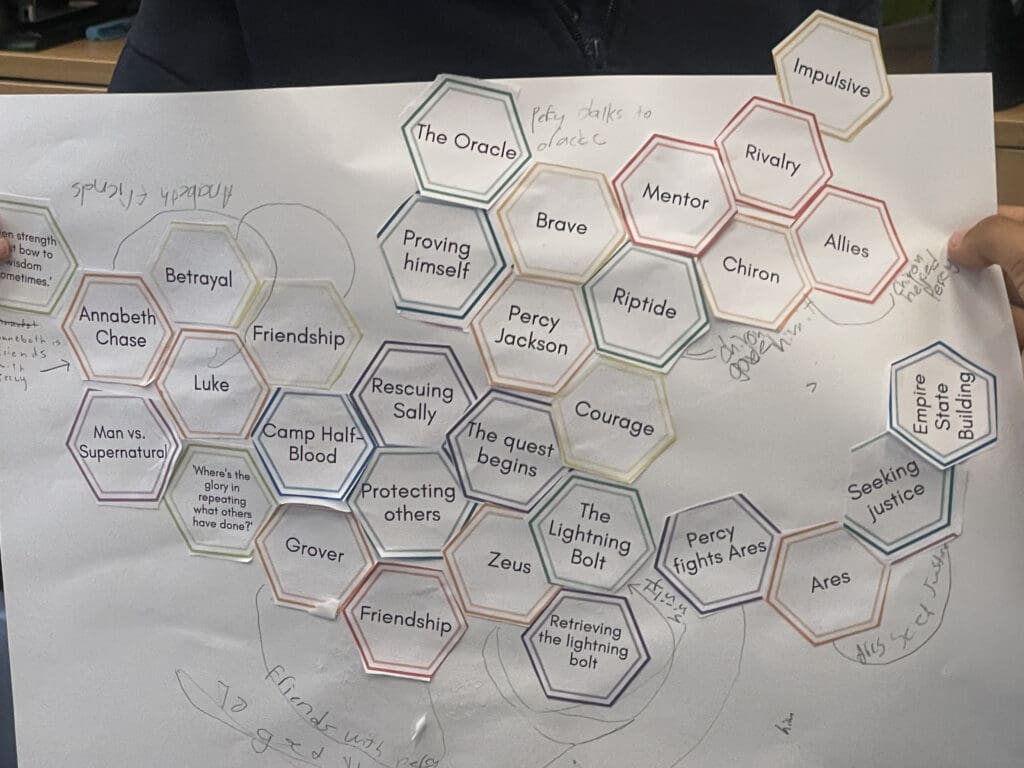
Why it builds rigor: There is no “right answer.” A student might connect “Water” to “Rebirth” or “Water” to “Danger.” The magic happens in the productive struggle of deciding where the pieces fit and defending those connections to their peers. This is one of those novel study activities that reveals layers of the book you might not have even seen yourself. Check out my blog post on how to create your own hexagonal thinking templates and grab your free hexagonal thinking assessment pack as well.
3. The “Silent Discussion” (Gallery Walk Style)
The Shift: Replacing the “Quote Analysis” worksheet with collaborative inquiry.
How to do it: Hang 5-6 “Hot Take” quotes from the novel around the room on large chart paper. Students rotate in silence, writing their interpretations and—this is the key—responding to what other students wrote.
Why it builds rigor: It creates a continuous revision loop. Students see how their peers interpreted the same line differently, forcing them to rethink their own original stance. It’s a low-pressure way to build the skills needed for a Socratic Seminar.
4. Visual Storyboarding: Graphic Novel Study Activities
The Shift: Replacing the “Summary Paragraph” with visual literacy.
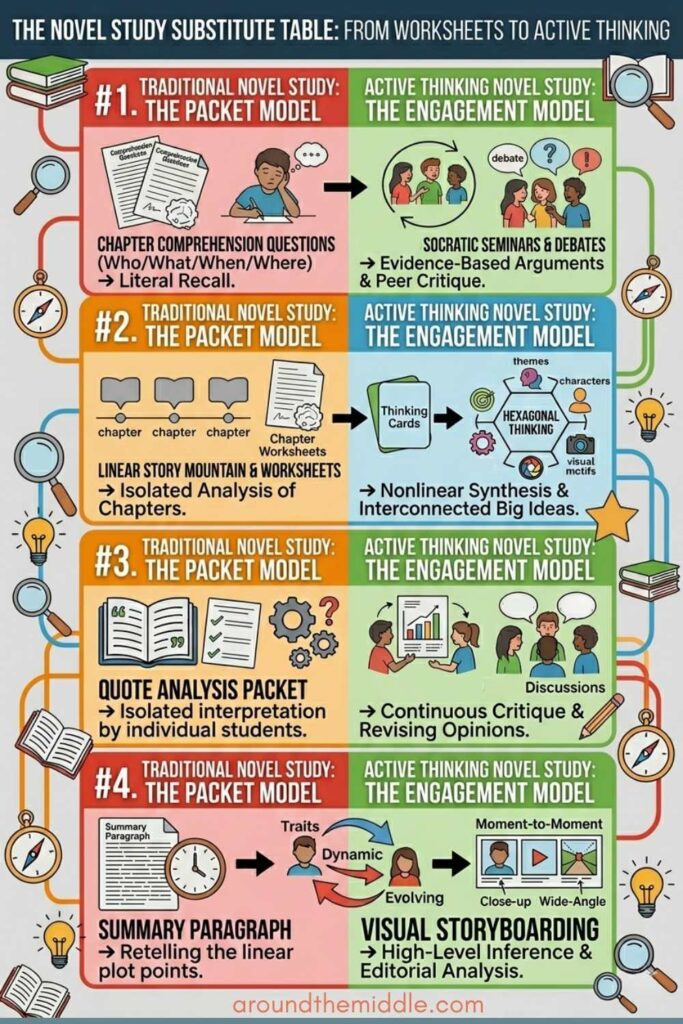
How to do it: Ask students to map a key scene using only three panels. However, they must use specific visual literacy terminology:
- Close-up: To show character emotion.
- Wide Angle: To show a character’s isolation or environment.
- Moment-to-Moment transitions: To slow down a high-tension scene.
Why it builds rigor: To draw a scene in three panels, a student has to infer what the most critical moments are. They aren’t just retelling the plot; they are acting as the “editor” of the story.
5. The Metacognitive Bento (The Synthesis Phase)
The Shift: Turning assessment into a final act of critical thinking.
How to do it: Instead of a quiz, give students a “Bento” template with five compartments: The Main Idea (Claim), Evidence, Peer Feedback, The Why (Analysis), and a Revised Opinion.
Why it builds rigor: Most novel study activities end when the student writes their answer. This activity forces them to test their answer against their peers. By requiring a “Revised Opinion,” you are rewarding students for being open-minded and changing their stance based on evidence—the ultimate “Active Thinking” skill.
Assessing These Novel Study Activities Without a Worksheet
I know the biggest fear: “How do I grade this?” Assessment doesn’t have to be a 10-point quiz. Try a Thinking Skills Rubric that grades the quality of the argument rather than the correctness of the fact.
You can even do “Micro-Grades” where you only assess one compartment of the Bento (like Peer Feedback) to keep your grading pile manageable while still providing high-utility feedback.
What’s Next in the Series?
Ditching the chapter questions is a huge step toward an active thinking classroom. But once you have the students talking through these novel study activities, how do you steer that talk toward the deep, abstract themes of a novel?
That’s exactly what we’re covering in Post 3: Teaching Theme Through Discussion (Not Worksheets).
Continue the Series:
- Post 1: Why Most Novel Studies Fall Flat (And How to Fix It)
- Post 3: Teaching Theme Through Discussion (Not Worksheets)
Ready to get your students moving? If you want ready-to-use, movement-based novel study activities, check out my Hexagonal Thinking, Debate, and Escape Rooms on Teachers Pay Teachers. They are designed to get students out of their seats and thinking critically—no packets required. Ready to plan your entire novel study unit in one afternoon the check out my walk-through.
Browse the “In Around the Middle” TPT Store
Happy teaching!