Tired of the “Theme” Struggle? 5 Powerful Novel Study Activities for Deep Discussion
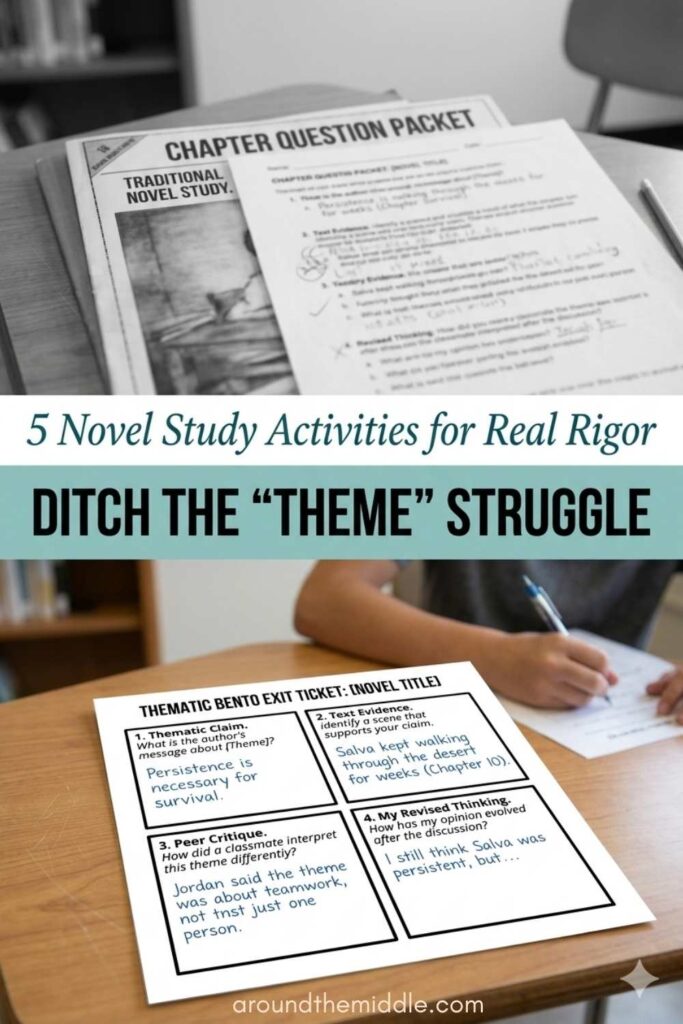
If you ask a middle schooler, “What is the theme of this book?” you’ll likely get one of two things: a blank stare or a one-word answer like “friendship” or “war.” Not exactly what you want from your novel study activities.
In my experience, students often treat theme like a “hidden treasure”—a secret code they have to crack to make the teacher happy. But as I’ve written before in Teaching Theme in Literature Made Easy, theme isn’t a secret. It’s a human conversation the author is having with us.
If we want students to join that conversation, we have to move beyond the “What is the theme?” worksheet and into novel study activities that bridge the gap between plot and abstract thinking..

Why Theme is the Engine of “Active Thinking” When it comes to novel study activities
The reason I’m so obsessed with theme is that it is the ultimate “High-Floor, High-Ceiling” concept. Every student understands the feeling of a theme like “betrayal,” but the productive struggle comes when they have to prove how that betrayal changes the protagonist’s identity.
This is exactly why my Hexagonal Thinking Novel Study products are built entirely around the themes of the novel rather than just plot points. I don’t want students to just tell me what happened; I want them to see how the author used motifs and characters to build a big idea. When students have to physically connect a hexagon labeled “Survival” to one labeled “Brian’s Hatchet,” they are doing the heavy lifting of literary analysis through movement and logic.
1. Thematic Hexagonal Thinking: Interconnected Novel Study Activities
The Shift: Moving from a list of themes to a map of connections.
How to do it: Give students hexagons containing characters, symbols, and thematic topics. Their job is to arrange them so that every touching side represents a logical connection.
The Power of Theme: Because my Hexagonal Thinking kits are theme-centered, students might find themselves connecting “Power” to “Fear” and “The Giver.” As they debate where a piece fits, they are naturally moving from a topic (“Power”) to a thematic statement (“Power used through fear leads to a loss of identity”).
2. The “Lens” Method: Visual Novel Study Activities
The Shift: Using visual literacy to “see” the theme.
How to do it: Ask students to find a pivotal moment and describe it as if they were the director of a film or graphic novel.

- The Close-Up: What emotion is the author “zooming in” on to show a thematic shift?
- The Wide-Angle: How does the setting reflect the theme of “Isolation” or “Chaos”?
Why it works: By treating the text like a visual medium, students realize the author is choosing what we see to emphasize the message.
3. Socratic Seminars: The Inner/Outer Circle
The Shift: Turning a teacher-led Q&A into a student-led thematic debate.
How to do it: The “Inner Circle” discusses one of our Universal Questions (e.g., “When is it ‘right’ to do something ‘wrong’?”). Meanwhile, the “Outer Circle” acts as the “Editorial Team,” tracking every time a student uses a specific motif or symbol as evidence to support a thematic claim.
If you’re not sure where to start with Socratic Seminars, check out my blog series on it here.
4. Thematic “Four Corners” (Movement-Based Learning)
The Shift: Physically moving based on thematic interpretation.
How to do it: Label the four corners of your room with different thematic statements related to the book. For example, in The Giver:
- Safety is worth the cost of freedom.
- Pain is necessary for true wisdom.
- Ignorance is bliss.
- Total equality is a dangerous myth.
Students move to the corner they most agree with after a specific chapter and must defend their choice using text evidence.
5. The Thematic Bento: Synthesis & Revision for any novel study activities
The Shift: Ending the lesson with a metacognitive “snap” of the day’s discussion.
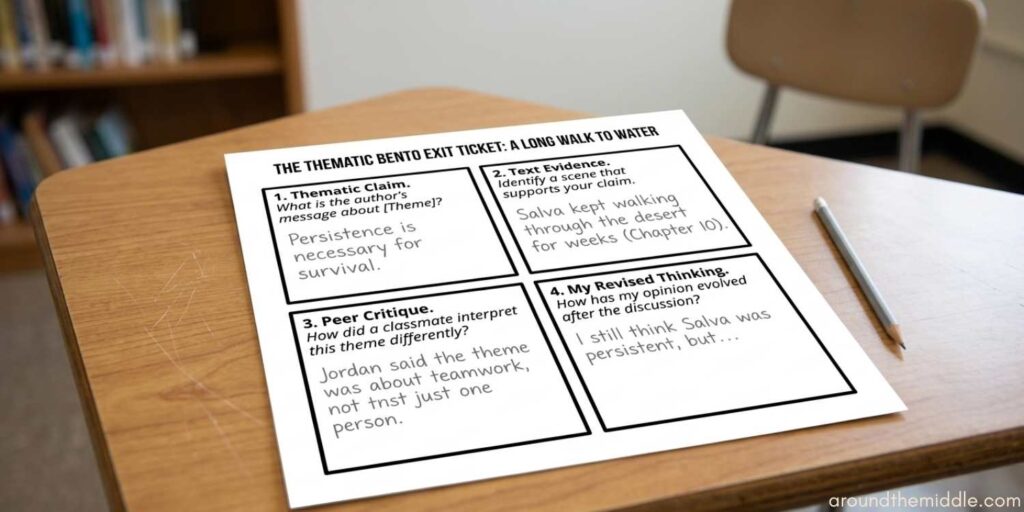
How to do it: If the first four activities are about generating ideas, this fifth activity is about capturing them. The Exit Ticket Bento is where the productive struggle is documented, moving assessment from a “gotcha” quiz to a final act of critical thinking. As seen in the example for A Long Walk to Water, students use the four distinct compartments to synthesize the entire class period:
- Thematic Claim: What is the author’s message about [Theme]?
- Text Evidence: Identify a specific scene or quote that supports your claim.
- Peer Critique: How did a classmate’s interpretation during the activity differ from your own?
- My Revised Thinking: How has your opinion evolved after hearing the discussion?
Moving Toward Rigorous, Theme-Based Thinking
When we center our novel study activities around theme, we stop asking students to be “detectives” searching for a “correct” answer and start asking them to be “architects” building their own meaning.
If you’re ready to let your students do the heavy lifting, my Hexagonal Thinking kits are designed to spark these exact conversations. They center every connection around the powerful themes your students need to master, taking the “prep struggle” off your plate so you can focus on the “productive struggle” in theirs.
Explore Theme-Based Hexagonal Thinking Kits in my TPT Store
Continue the Series:
In case you missed the first two posts in the series, you can go back and read them with the links below.
Post 2: 5 Engaging Novel Study Activities to Stop the Worksheet Boredom
Post 1: Why Most Novel Studies Fall Flat (And How to Fix It)
Join the “Around the Middle” Community
If you’re ready to ditch the packets for good and build a classroom centered on active thinking, let’s stay connected. I’m constantly developing new, movement-based novel study activities designed to get your middle schoolers out of their seats and into the text.
💌 Get Tips & Freebies in Your Inbox
Join our email community of fellow educators! When you sign up, you’ll get weekly tips, exclusive “Thinking in Motion” strategies, and first access to my latest freebies delivered straight to your inbox.
Click Here to Join the Newsletter
🛍️ Follow My TpT Store
Don’t miss a beat (or a new resource). Follow In Around the Middle on Teachers Pay Teachers to be the first to know when I drop new novel, product lines and more!
Follow “In Around the Middle” on TpT
Happy Teaching!