
Teaching Character Traits Made Powerful and Simple
Lessons That Go Beyond “Nice” and “Mean”
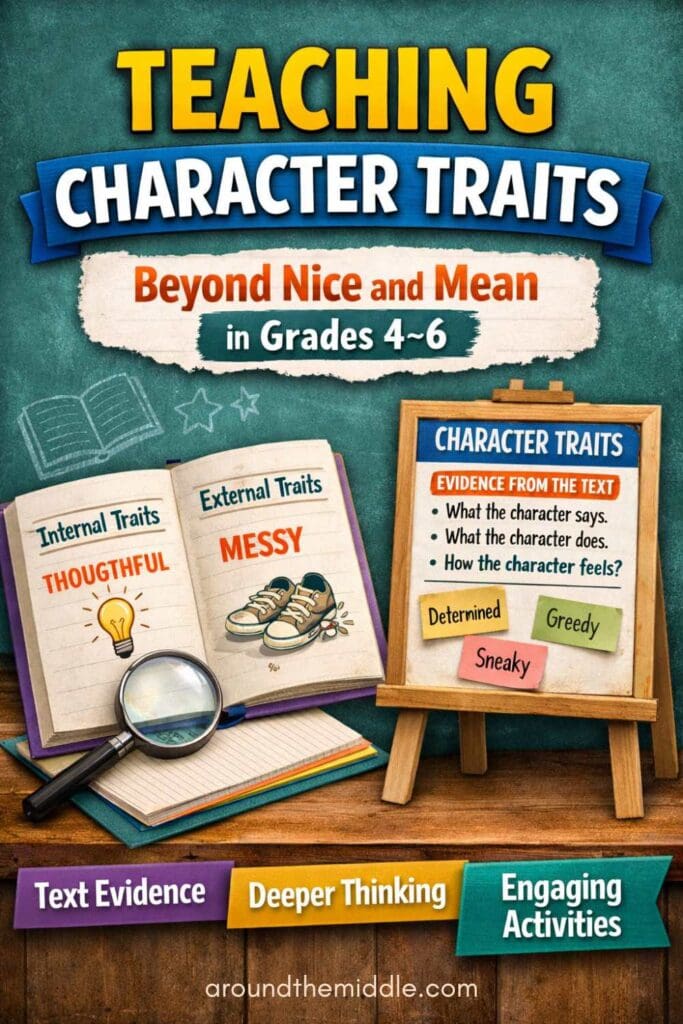
Teaching character traits should be about depth, evidence, and growth—not surface-level labels students recycle because they think that’s what we want to hear. Yet many upper elementary classrooms still get stuck at “kind,” “mean,” or “brave,” with little justification and even less nuance.
If your students can name a trait but struggle to explain why it fits—or how it changes—this isn’t a student problem. It’s an instructional one. Effective teaching character traits requires deliberate modelling, consistent language, and lesson character traits that push thinking beyond the obvious.
This post breaks down how to teach character traits in a way that actually sticks.
Why Teaching Character Traits Matters
By Grades 4–6, students are expected to move past identifying traits and start analysing characters as complex, changing individuals. Teaching character traits at this level directly supports:
- Reading comprehension and inference
- Text-based evidence in written responses
- Deeper discussion and justification
- Stronger character analysis across novels
The problem is that many lesson character traits stop short. Students identify a trait, tick the box, and move on. There’s no return to that character, no revisiting the trait, and no discussion of whether it still applies later in the text.
That approach doesn’t build understanding. It builds compliance.
Common Mistakes When Teaching Character Traits
Before improving instruction, it’s worth being blunt about what doesn’t work.
One of the biggest issues in teaching character traits is confusing traits with emotions or behaviours. “Sad,” “angry,” or “yelling” are not character traits—but students use them because they haven’t been taught the difference explicitly.
Another common mistake is accepting traits without evidence. If students can name a trait but can’t point to dialogue, actions, or decisions to support it, the learning is shallow.
Finally, many lesson character traits are taught as one-off activities. Traits are introduced, practised once, and never revisited. That’s why students struggle to transfer the skill to a new text.
Teaching Character Traits With a Clear Lesson Structure
Strong teaching character traits begins with intentional lesson design. A solid lesson character traits framework includes three non-negotiables:
- Explicit modelling
Teachers need to think aloud. Show students how you decide on a trait, how you reject weak options, and how you justify stronger ones with evidence. - Guided practice with accountability
Students should practise identifying traits and explaining their reasoning—verbally and in writing. - Revisiting traits across the text
A character trait introduced in Chapter 3 should be challenged in Chapter 10. This is where real analysis happens.
Without this structure, students default to guessing what sounds right instead of thinking critically.
Teaching Internal and External Character Traits Explicitly
A turning point in teaching character traits is helping students understand the difference between internal and external traits.
External traits are observable—what the character looks like or how they behave. Internal traits relate to personality, values, and motivations.
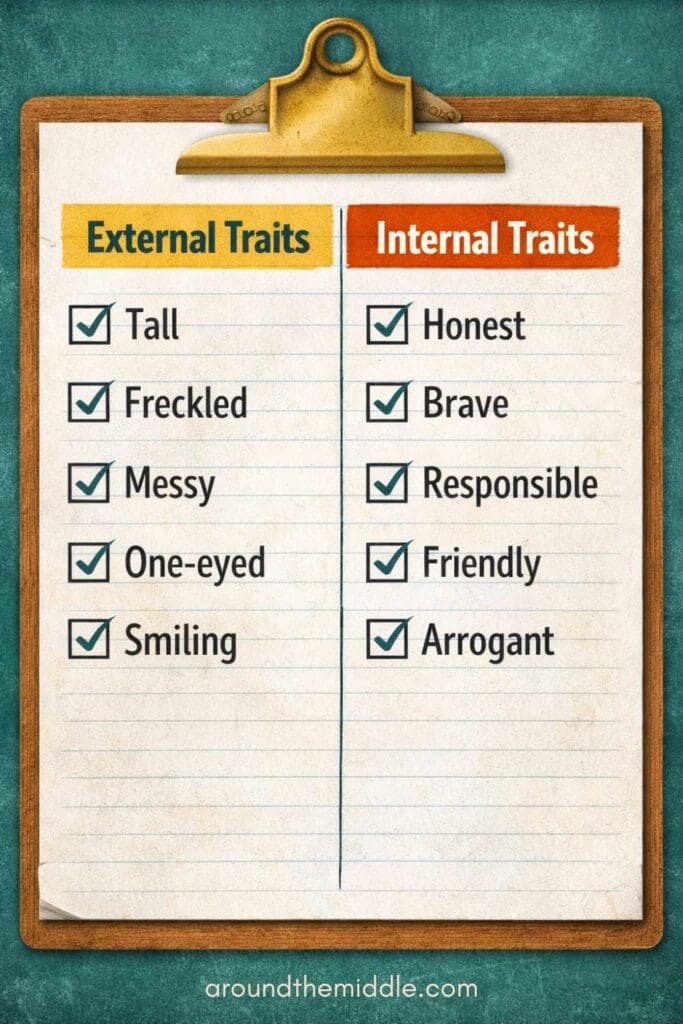
This distinction matters because it forces students to move beyond surface details. When lesson character traits require students to justify internal traits, they must infer, not just observe.
At this level, students should regularly be asked:
- Is this trait something we see or something we infer?
- What evidence supports that inference?
- Does the trait stay consistent, or does it shift?
These questions raise the level of thinking immediately.
Character Traits Activities That Actually Build Depth
Effective lesson character traits are not about novelty. They’re about repeated, meaningful practice.
High-impact strategies include:
- Trait sorting with justification (not matching)
- Tracking how a character’s traits are revealed through decisions
- Comparing early and late traits to identify growth or change
- Partner discussions where students must challenge each other’s choices
If you’re looking for more creative ways to extend this work, this post on character analysis activities pairs well with explicit teaching character traits instruction:
👉 Irresistibly Creative Character Analysis Activities Your Students Will Love
The key is that activities should force students to defend their thinking—not just name a trait and move on.
Teaching Character Traits Beyond Basic Vocabulary
Upper elementary students need support moving beyond basic traits, but handing them a word list isn’t enough.
Teaching character traits effectively means showing students how similar traits differ. Determined and stubborn are not interchangeable. Confident and arrogant are not the same.
Build lesson character traits that require students to:
- Compare two traits and justify which fits better
- Explain why one trait is more precise than another
- Revise a trait when new evidence emerges
Precision is what separates strong analysis from weak responses.
Assessing Character Traits Without Busywork
If assessment only checks whether students can name a trait, it’s not measuring understanding.
Better options include:
- Short written responses requiring evidence
- Oral explanations during reading conferences
- Exit prompts asking whether a trait still applies and why
- Revisiting a previous trait and revising it based on new events
Teaching character traits well means assessing thinking, not recall.
Making Character Traits Stick All Year
The biggest shift in teaching character traits comes when traits are treated as ongoing ideas, not isolated skills.
Revisit them across:
- Multiple chapters
- Different texts
- Reading, writing, and discussion
When students see that character traits are flexible, debatable, and evidence-based, their responses deepen—and stay that way.
Final Thoughts on Teaching Character Traits With Purpose
Teaching character traits in Grades 4–6 works best when students are expected to think, justify, and revise their ideas—not rush to the “right” answer. Strong lesson character traits deliberately create moments where students have to pause, wrestle with evidence, and defend their thinking.
That productive struggle is where real learning happens.
If your students need support moving beyond surface-level traits and into deeper analysis, this free Productive Struggle resource is designed to support teachers to know when to step in and when to allow students to struggle through:
👉 Download the Productive Struggle Freebie
When teaching character traits is intentional, consistent, and evidence-driven, students stop guessing what sounds good and start explaining what the text actually shows—and that’s the goal.
Happy teaching!