Movement-Based Learning That Students Love
Movement-Based Learning as a Cognitive Tool: Why Movement Improves Memory and Engagement
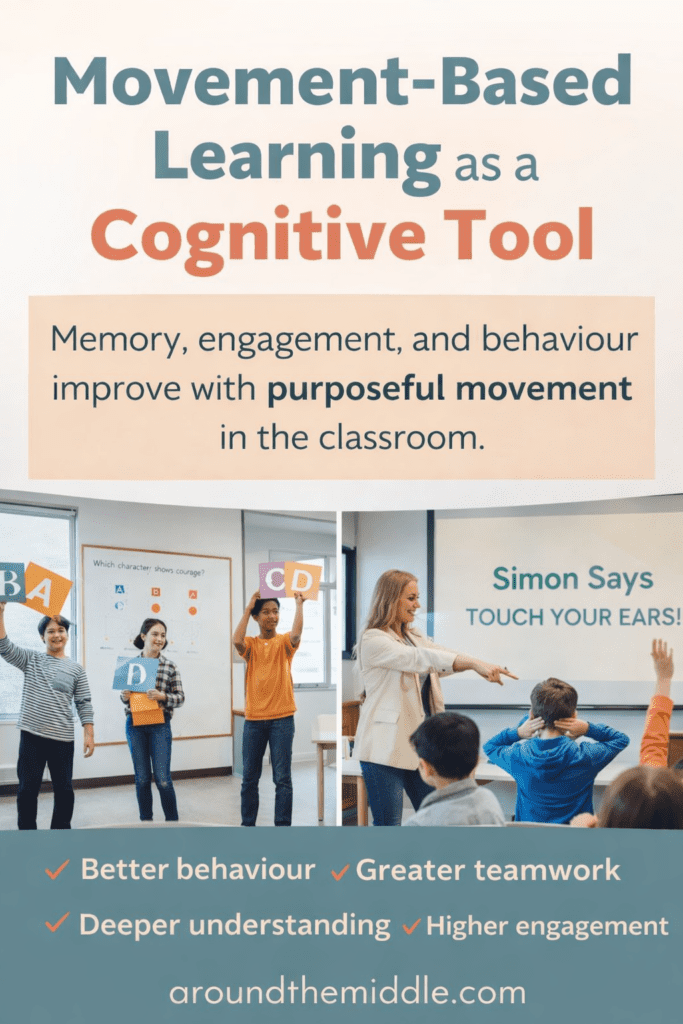
Movement-based learning is often misunderstood. In many classrooms, movement is treated as a break from learning — something students earn once the “real work” is done. In reality, movement is one of the most effective cognitive tools teachers have.
I am a strong believer in using movement in the classroom, not because it is trendy, but because I have seen firsthand what happens when learning is paired with purposeful physical engagement. Over time, my own classroom experience has consistently shown improved behaviour, stronger teamwork, richer discussions where students build on each other’s thinking, and noticeably higher engagement. That belief is the reason movement is embedded intentionally throughout my teaching resources — not as a gimmick, but as a strategy.
When movement is planned with intention, it actively supports how students process, store, and retrieve information.
Why Movement-Based Learning Works at a Cognitive Level
Research in cognitive science and education consistently points to a simple truth: the brain learns better when the body is involved.
Studies around embodied cognition show that learning is strengthened when students physically interact with information rather than passively receive it. Movement increases blood flow and oxygen to the brain, which supports attention and working memory. It also activates multiple neural pathways, making learning more durable.
In plain teacher terms:
- Students focus longer
- Ideas stick better
- Learning feels less effortful
Movement-based learning is not about adding noise or chaos. It is about supporting the brain’s natural learning processes. Check out last week’s post for tips on how to handle movement.
Movement and Memory: Why Students Remember More
Memory improves when learning is multi-sensory. When students move while thinking, they create physical anchors for abstract ideas.
Educational research highlights three key mechanisms:
- Deeper encoding: Movement adds a physical layer to memory storage
- Improved retrieval: Physical cues help students recall information later
- Reduced cognitive overload: Movement breaks up heavy processing demands
This explains why students often remember content taught through movement long after worksheet-based lessons fade.
Movement and Engagement: Why Behaviour Improves Too
One of the most underestimated benefits of movement-based learning is its impact on behaviour.
In my own classroom, purposeful movement consistently led to:
- Fewer off-task behaviours
- Improved collaboration and teamwork
- Students listening to and building on each other’s ideas
- Higher participation from reluctant learners
When students are physically involved, they are mentally invested. Movement gives them a role in the learning process rather than positioning them as passive recipients.
Practical Movement-Based Learning Strategies That Support Cognition
Movement works best when it is directly tied to thinking. Below are classroom-ready strategies that support comprehension, memory, and engagement.
Strategy 1: Simon Says for Comprehension Checks
Instead of using Simon Says for classroom management, repurpose it as a comprehension tool.
How it works:
- The teacher reads a statement related to the text or concept
- Students only perform the action if the statement is correct
Why it works cognitively:
- Requires active listening
- Forces evaluation, not guessing
- Strengthens comprehension monitoring
This strategy supports inhibitory control — a key executive function tied to learning.
Strategy 2: Movement Choices for Answer Selection
Turn multiple-choice questions into physical decision-making.
How it works:
- Corners of the room represent answer options
- Students move to the option they believe is correct
- Students justify their choice verbally or in writing
Why it works cognitively:
- Encourages retrieval practice
- Makes thinking visible
- Creates opportunities for peer learning
This approach consistently improves engagement and discussion quality.
Strategy 3: Gesture-Based Vocabulary and Concepts
Have students create gestures to represent vocabulary words or abstract ideas.
Why it works cognitively:
- Supports embodied cognition
- Strengthens long-term retention
- Helps abstract language become concrete
Students often recall the gesture first — and the meaning follows.
Strategy 4: Stand, Sit, or Step for Formative Assessment
Quick movement signals allow teachers to check understanding without disrupting lesson flow.
Examples:
- Stand if you agree, sit if you disagree
- Step forward if confident, stay still if unsure
Why it works cognitively:
- Low-risk participation
- Immediate feedback
- Maintains attention without breaking focus
When Movement-Based Learning Works — and When It Doesn’t
Movement is powerful, but only when used intentionally.
Effective movement-based learning:
- Is brief and structured
- Has a clear academic purpose
- Includes accountability
Movement loses its impact when it is random, overused, or disconnected from learning goals.
Designing Lessons With Movement as a Cognitive Support
When planning for movement-based learning, the key is not when students move, but why they move.
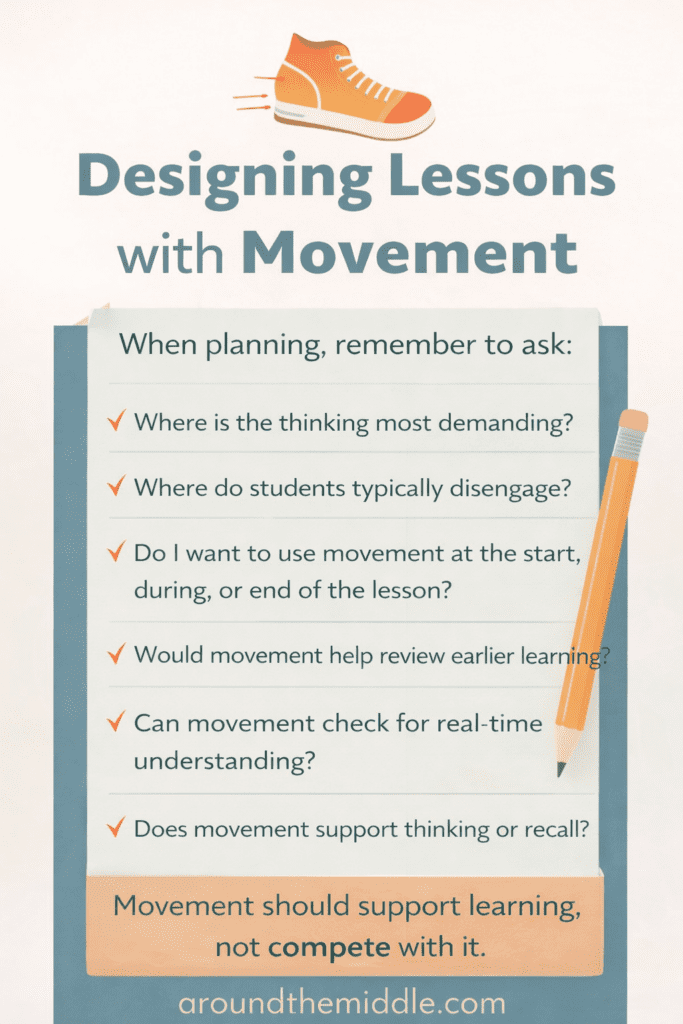
As you plan, consider:
- Where is the thinking most demanding?
- Where do students typically disengage?
- What kind of processing do students need at that point in the lesson?
Short, intentional movement tools can be especially effective as:
- A quick way to revisit learning from the previous lesson
- An “exit slip” style activity to check understanding at the end
- A brief check-in during instruction to gauge comprehension in real time
Where movement fits best will depend on what you — and your students — need from that lesson. Sometimes it supports recall, sometimes it supports processing, and sometimes it simply keeps thinking active when attention starts to fade.
In all cases, movement should support learning, not compete with it.
Why My Teaching Resources Are Built Around Movement-based learning
My belief in movement-based learning is grounded in experience. Over time, I saw clear patterns:
- Better behaviour because students were meaningfully engaged
- Stronger teamwork through shared problem-solving
- Deeper understanding as students built on each other’s ideas
- Higher engagement across all learners
That is why my classroom resources intentionally incorporate movement — through scavenger hunts, debates, escape-room challenges, and active review strategies. They are designed to support cognition, not just keep students busy.
Final Thoughts
Movement-based learning is not a trend. It is a research-supported, classroom-proven strategy that strengthens memory, engagement, and collaboration.
When movement is used deliberately, it becomes a cognitive tool — one that helps students learn more deeply and teachers teach more effectively.
Start small. Add movement where thinking is hardest. The impact is immediate and lasting. You’ve gotten this far, don’t forget to join my newsletter for more tips and ideas for your classroom! And if you’re looking for some low-prep, ready to go movement activities, check out my store here!
Happy teaching!