Reclaim Your Sunday! Grading Novel Study Activities Without The Burnout
We’ve all been there. It’s Sunday afternoon, and while the rest of the world is relaxing, you’re buried under a mountain of 120 chapter-question packets. Your red pen is running dry, and—let’s be honest—you know half of those answers were copied from a summary site anyway. The joys of grading novel study activities!
If we want to move away from the “packet culture” I discussed in Post 1, we have to change how we think about the “Monday Morning Pile.” The secret isn’t grading faster; it’s changing when the grading happens. By grading novel study activities as they occur, you aren’t just saving your weekend—you’re providing feedback when students are still actually thinking about the book.
Grading Novel Study Activities in Real Time: The Socratic Shortcut
The biggest hurdle to student-led discussions like Socratic Seminars is the fear that you won’t be able to “prove” what happened for a grade. But you don’t need a transcript to assess a seminar. You need a clipboard.
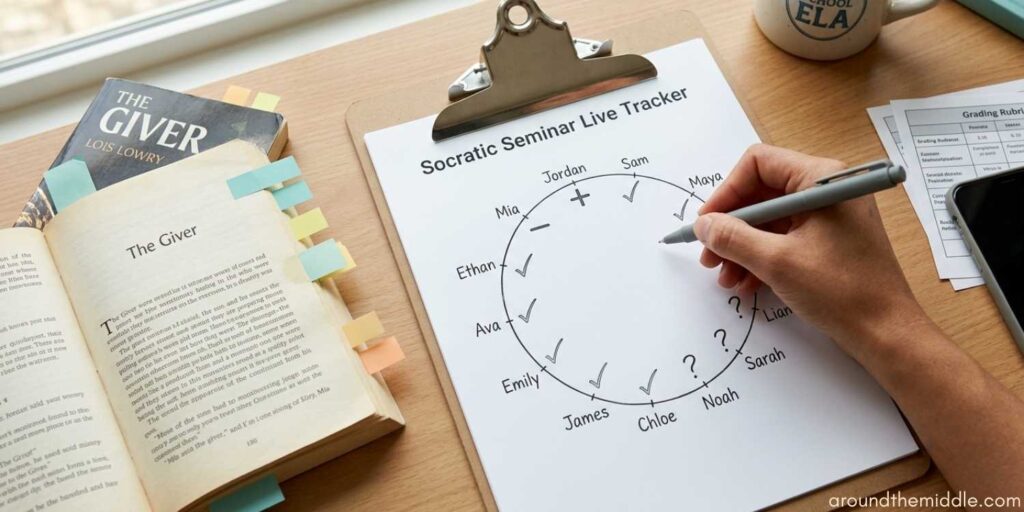
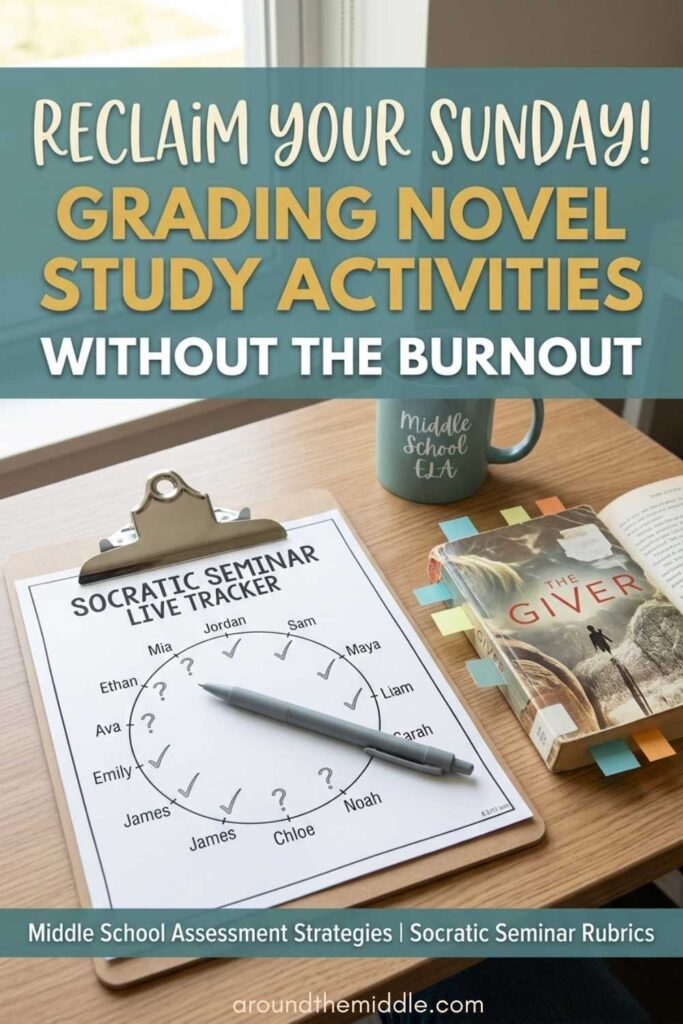
Instead of grading a reflection after the seminar, use a “Live Tracker.” While students are in the inner circle, use a simple seating chart rubric to check off specific behaviors:
- The Checkmark: Used a specific piece of text evidence.
- The Plus Sign: Built on a peer’s idea (“To add to what Jordan said…”).
- The Question Mark: Asked a clarifying or deepening question.
By the time the bell rings, your grading novel study activities for that period is 90% finished. You’ve captured the “Active Thinking” in the moment, and the students get their “grade” while the conversation is still fresh in their minds. If you’re looking for more on running Socratic seminars, check out my blog series.
Grading Novel Study Activities Like Hexagonal Thinking: Defense over Design
One of the most frequent questions I get is, “How do I grade 30 groups doing Hexagonal Thinking without losing my mind?” The trick is to stop trying to grade the “map” and start grading the logic. You don’t need to verify every single connection on the desk. Instead, pivot your assessment to the defense:
- The Gallery Walk: Have groups leave a “Connection Card” next to their most controversial or complex connection.
- The Highlighter Method: Walk around while they are working. Ask a group to defend the connection between “Identity” and “The Giver.” If they can explain it with rigor, they’ve met the standard.
Pro-Tip: If you want to see exactly how I streamline this, you can grab my Hexagonal Thinking Assessment Freebie here. It includes the connection cards and a simplified rubric to make your “logic checks” a breeze. I’ve also written an entire post on assessing hexagonal thinking here.
The Single-Point Rubric: High-Utility Assessment
Traditional four-column rubrics are often a wall of text that students ignore. For middle schoolers, we want to prioritize productive struggle and clarity.
The Single-Point Rubric is the “Editorial” style of assessment. It features the “Target Standard” in the center, with blank space on either side for “Evidence of Growth” and “Exceeding Expectations.”
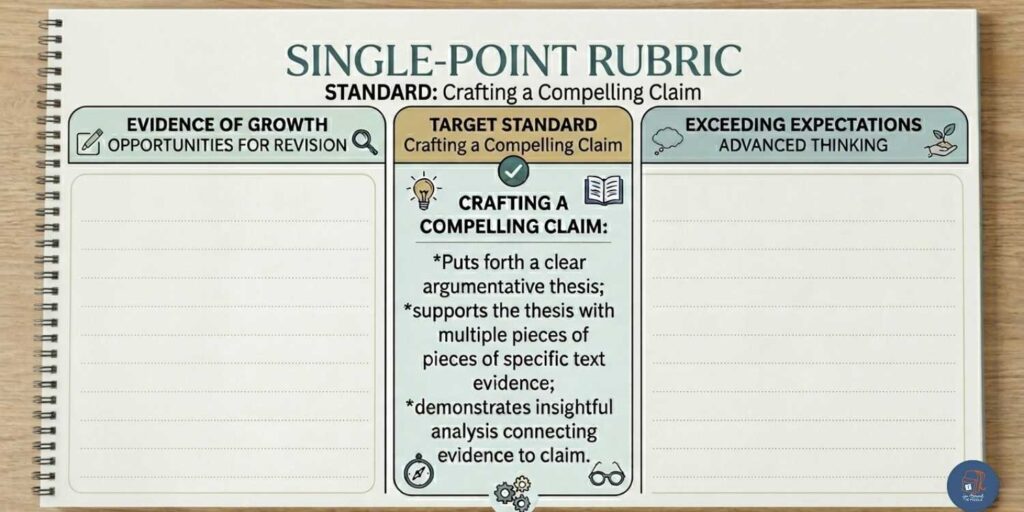
When grading novel study activities with this format, you aren’t hunting for points to deduct. You are looking at the work and asking: Did they meet the goal? This allows for much more meaningful, “mentor-peer” feedback without the overhead of complex point calculations.
Bento Spot-Checks: The Micro-Grade
The “Thematic Bento” we discussed in Post 3 is a goldmine for data, but you don’t have to grade all four compartments every time.
If you’re feeling the “grading mountain” start to grow, announce a Spot-Check. Tell the class: “Today, I am only grading Compartment 4 (Revised Thinking). I want to see how your brain changed during our Four Corners debate.”
Why this works:
- It cuts your grading time by 75%.
- It signals to students that “Revised Thinking” is a high-value skill.
- It keeps the rigor high because they never know which compartment you’ll pick next time.
Rigor Without the Burnout
Assessment should be a mirror for the student, not a weight for the teacher. When we prioritize grading novel study activities in the moment, we stop being “autopsy doctors” examining dead work and start being “coaches” in the middle of the play.
Ready to reclaim your Sunday? Let’s start assessing the thinking, not just the ink.
Join the “Around the Middle” Community
Ready to simplify your classroom? I’m here to help you build a high-rigor, low-burnout ELA room.
- 💌 Get Tips & Freebies: Join my email community for weekly “Active Thinking” strategies and exclusive freebies. Sign up here!
- 🛍️ Shop the Store: For classroom-ready rubrics and movement-based units, follow In Around the Middle on TpT.
Happy Teaching!