Proven Socratic Seminar Ideas for Novel Studies Teachers Can Trust
How to Get Started with Purposeful Classroom Discussions
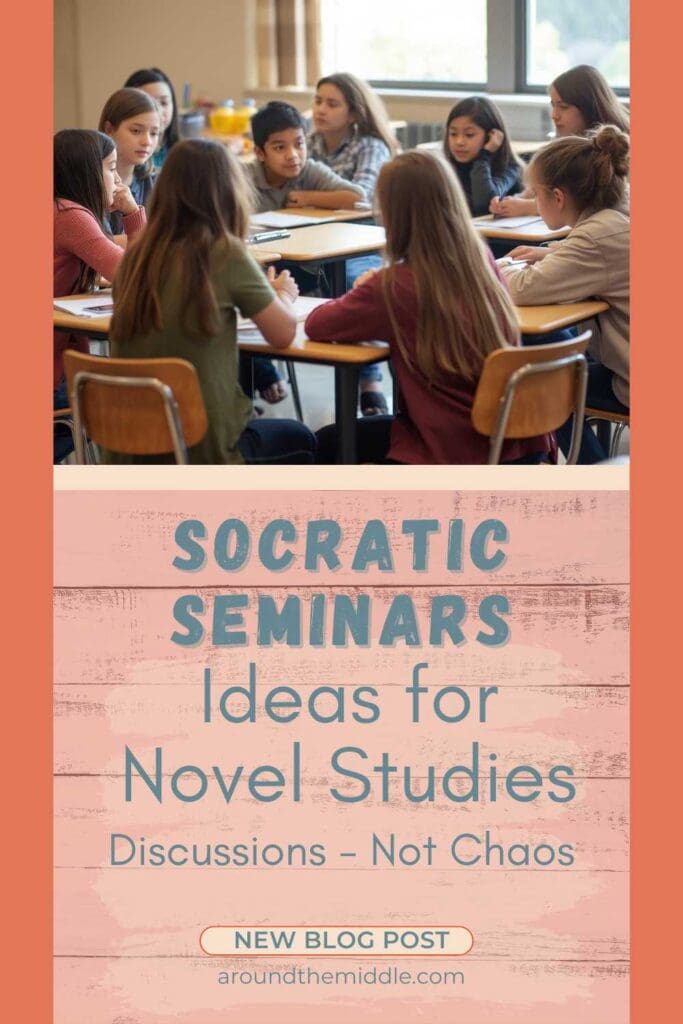
If you are looking for socratic seminar ideas for novel studies, chances are you want more than surface-level comprehension questions and teacher-led discussions that go nowhere. You want students thinking deeply about texts, responding to one another, and backing up ideas with evidence—not just raising hands to please the teacher.
This is Part 1 of a 3-part series designed to help you confidently implement Socratic seminars as part of your novel studies—without overwhelm, wasted lesson time, or awkward first attempts that put you off the strategy entirely.
Socratic seminars offer a structured, student-led approach to discussion that fits naturally into novel studies. When done well, they promote critical thinking, respectful dialogue, and meaningful engagement with literature. When done poorly, they can feel chaotic, intimidating, or dominated by a few confident voices.
This post focuses on what Socratic seminars actually are, why they work so well with novels, and where they fit within a novel study. Later posts will break down preparation and practical classroom execution.

What Is a Socratic Seminar (and What It Is Not)?
Before exploring socratic seminar ideas for novel studies, it is essential to clarify what a Socratic seminar is—and what it is not.
A Socratic seminar is a structured, student-led discussion centred on an open-ended question and grounded in a shared text. Students are expected to listen, respond thoughtfully, and support their ideas with evidence from the novel.

A Socratic seminar is not:
- A debate with winners and losers
- A free-for-all discussion with no accountability
- A teacher-led question-and-answer session
- A literature circle with assigned jobs and worksheets
Instead, it is a guided conversation where students explore ideas together, question assumptions, and deepen understanding of the text.
Why Socratic Seminars Belong in Novel Studies
When teachers search for socratic seminar ideas for novel studies, they are often trying to solve a familiar problem: students can recall plot details, but struggle to discuss themes, character motivation, or author intent.
Socratic seminars address this gap.
1. Novels naturally invite discussion
Novels are rich with moral dilemmas, conflicting perspectives, and ambiguous moments. These are ideal conditions for open-ended questions and meaningful dialogue.
2. They move students beyond “right answers”
Novel studies are not about finding one correct interpretation. Socratic seminars encourage students to justify ideas, reconsider positions, and engage with multiple viewpoints.
3. They support productive struggle
Strong Socratic seminars place students in a space where thinking feels challenging—but achievable. This type of cognitive effort is exactly what drives deeper learning. If this idea resonates, you may also find this post helpful:
From Frustration to Breakthrough: Elevating Learning with Productive Struggle Activities
Socratic Seminar Ideas for Novel Studies at Different Stages
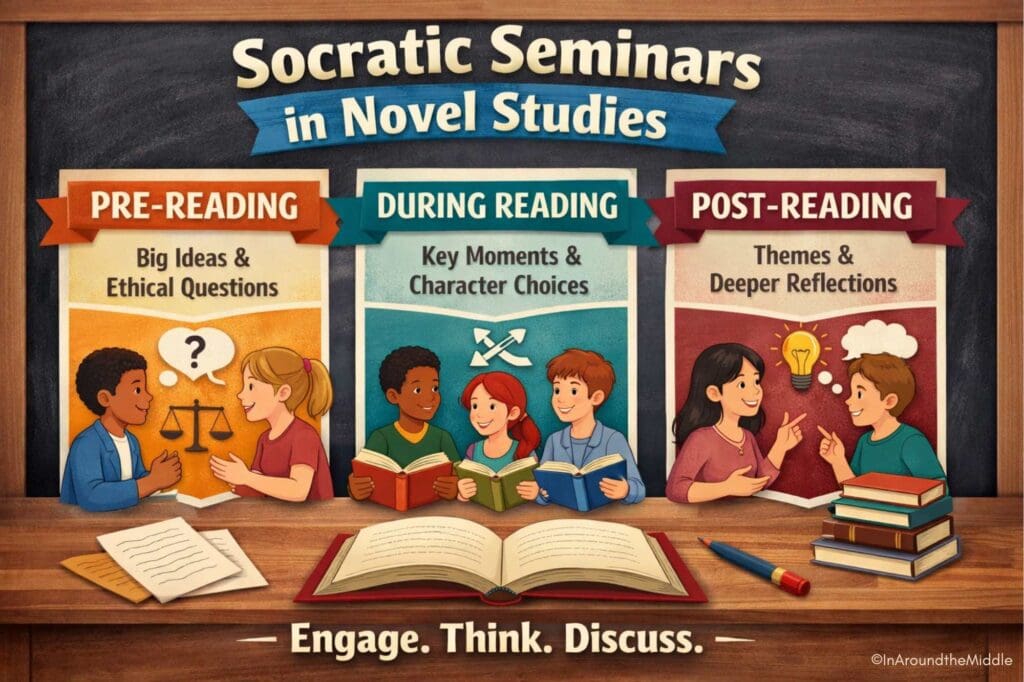
One of the most common misconceptions is that Socratic seminars only belong at the end of a novel. In reality, some of the most effective socratic seminar ideas for novel studies occur before and during reading.
Pre-Reading Socratic Seminar Ideas
Before students read a novel, seminars can be used to explore big ideas rather than plot.
Examples include:
- Ethical questions connected to the novel’s themes
- Statements students agree or disagree with before reading
- Real-world dilemmas related to the text’s context
These discussions activate prior knowledge and give students a conceptual lens for reading.
Mid-Novel Socratic Seminar Ideas
During a novel study, Socratic seminars work best at turning points.
Use them to explore:
- A major character decision
- A shift in power or relationships
- Conflicting motivations or perspectives
Mid-novel seminars help students slow down, reflect, and reconsider assumptions before rushing to the ending..
Post-Novel Socratic Seminar Ideas
After reading, Socratic seminars are ideal for synthesis.
Strong post-novel prompts focus on:
- Theme and author’s message
- Character growth or failure
- Unresolved questions or alternative endings
These discussions naturally lead into analytical or reflective writing tasks.
Who Socratic Seminars Work For (and Why Structure Matters)
Many teachers hesitate to try Socratic seminars because they worry about reluctant speakers or uneven participation. This is where intentional structure makes all the difference.
Socratic seminars can work for:
- Upper elementary students when scaffolding is explicit
- Middle school students when expectations are clear
- Reluctant speakers when listening is valued as much as talking
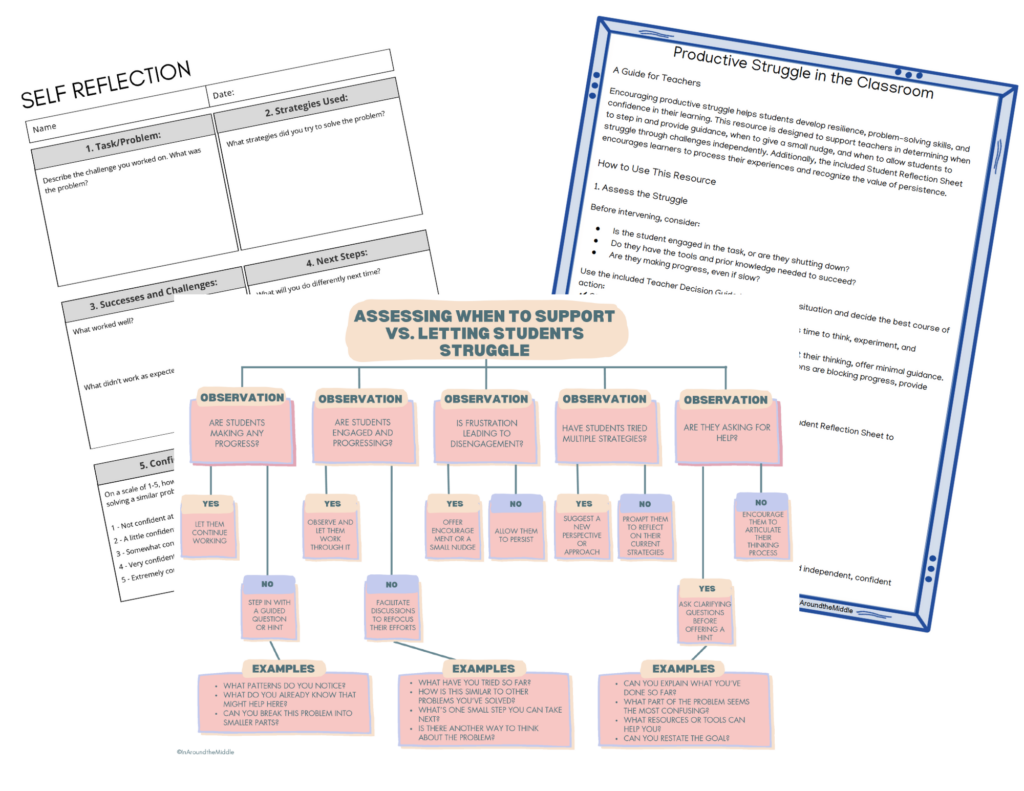
When students experience struggle that is productive rather than frustrating, confidence grows. This is the same principle behind my Productive Struggle Freebie, which supports students in persisting through challenging thinking tasks without shutting down.
👉 You can grab the Productive Struggle Freebie here to support this mindset before introducing Socratic seminars.
When Socratic Seminars Go Wrong
Teachers often abandon Socratic seminars after one unsuccessful attempt. In most cases, the issue is not the strategy—it is the setup.
Common problems include:
- Vague discussion questions
- No modelling of discussion behaviours
- No expectations for text evidence
- Too much freedom too soon
These issues are avoidable, and they will be addressed directly in the next post.
Why Socratic Seminars Are Worth the Effort
When implemented with intention, Socratic seminars transform novel studies from passive comprehension tasks into active thinking experiences. Students learn that their ideas matter—but only when they are supported, challenged, and refined through discussion.
If you are searching for socratic seminar ideas for novel studies that go beyond theory and actually work in real classrooms, clarity and structure are the starting point., debatable, and evidence-based, their responses deepen—and stay that way.
Coming Up Next in This 3-Part Series
In Part 2, we will focus on how to prepare students for Socratic seminars—including roles, norms, and scaffolds—so discussions stay purposeful instead of painful.
Part 3 will then tackle running and assessing Socratic seminars in a way that supports learning rather than shutting down student voice.
Happy teaching!